In December we took part in AI for the Global South (AI4GS) at the Mohamed bin Zayed University of Artificial Intelligence (MBZUAI) in Masdar City, Abu Dhabi.
On December 9, Luciana Benotti delivered the talk “Beyond AI raw data providing: How to increase technical AI knowledge in Latin America” during Plenary Session 2 – Technology.
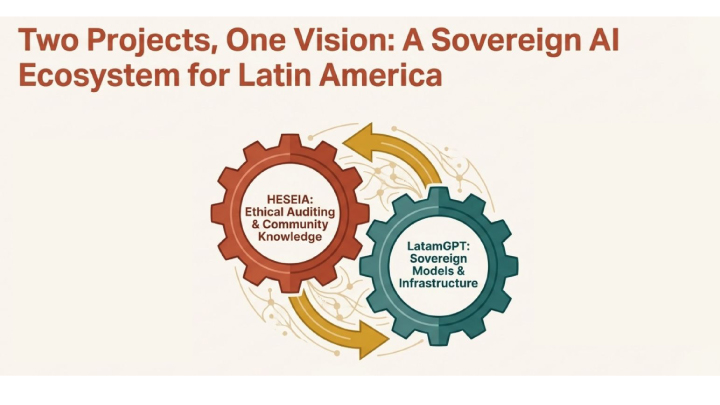
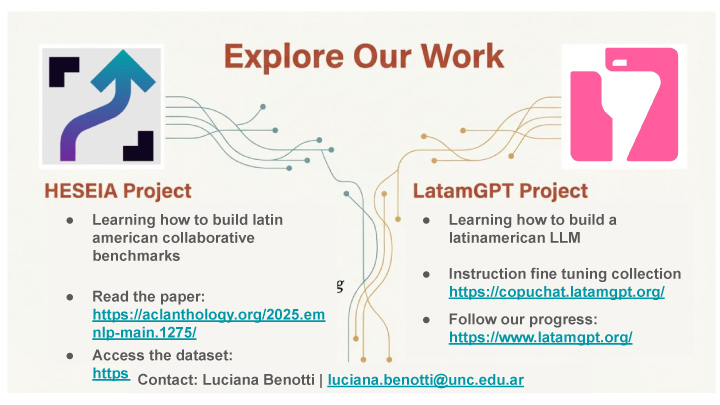
In her presentation, Luciana discussed our work on HESEIA, our project for assessing bias in language models, and and talked about Latam-GPT, a collaborative Latin American initiative to develop LLMs from local perspectives—promoting linguistic and cultural diversity, strengthening regional technical capacity, and advancing technological sovereignty.
In the photo: Luciana Benotti with Vukosi Marivate, Luis Chiruzzo, and Syed Ishtiaque Ahmed.
Although AI has made extraordinary progress, its benefits remain unevenly distributed. Research and development are still concentrated in the Global North, leaving vast opportunities for the Global South to take a more active role in shaping the future of AI.
Truly inclusive AI can only be achieved when local experts, community stakeholders, and lay users are involved throughout the entire lifecycle—from problem definition to model evaluation—instead of receiving external solutions that do not reflect their contexts.
Ground-up co-designed initiatives such as Masakhane or EDIA- https://ia.vialibre.org.ar/en/home/, demonstrate how AI can strengthen local talent, prevent brain drain, and foster real technological ownership.